Showing posts with label atheism. Show all posts
Showing posts with label atheism. Show all posts
Friday, October 4, 2024
Tuesday, July 9, 2024
Saturday, November 20, 2021
couldn't prove there is no god, but was an atheist

“The fundamental cause of the trouble in the modern world today is that the stupid are cocksure while the intelligent are full of doubt.”
—Bertrand Russell [1872-1970]


Sunday, September 6, 2020
Thursday, February 2, 2017
on atheism

"If you burned all the religious texts, they would be gone forever. But if you burned all the science texts, all the principles would eventually be rediscovered again."
- Ricky Gervais
Thursday, September 1, 2016

Thursday, March 24, 2016
Old Rhyme

We are the pure and chosen few
And all the rest are damnedThere’s room enough in hell for you
We don’t want heaven crammed.
- English Calvinism

Friday, February 26, 2016
atheist

"Left to themselves evil people will do evil things and good people will do good things. If you want good people to do evil things, that takes religion."
- Steven Weinberg
Sunday, March 14, 2010
conveyance of mental confusion

Portrait of Virginia Wolf by her sister Vanessa Bell, 1912
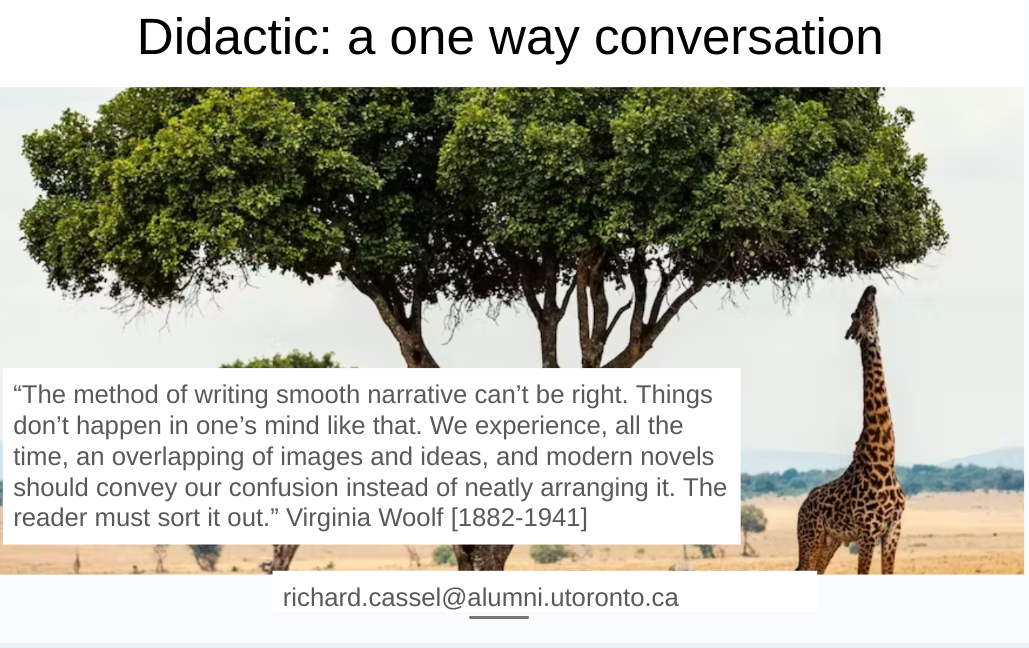
"The method of writing smooth narrative can't be right. Things don't happen in one's mind like that. We experience, all the time, an overlapping of images and ideas, and modern novels should convey our mental confusion instead of neatly arranging it. The reader must sort it out."
- Virginia Woolf [1882-1941]
Tuesday, October 20, 2009
atheist point of view
Religion Is Absurd
by Christopher Hitchens
Religion will always retain a certain tattered prestige because it was our first attempt as a species to make sense of the cosmos and of our own nature, and because it continues to ask "why". Its incurable disability, however, lies in its insistence that the answer to that question can be determined with certainty on the basis of revelation and faith.
We do not know, though we may assume, that our pre-homo sapiens ancestors (the erectus, the Cro-Magnons and the Neanderthals, with whom we have a traceable kinship as we do with other surviving primates) had deities that they sought to propitiate. Alas, no religion of which we are now aware has ever taken their existence into account, or indeed made any allowance for the tens and probably hundreds of thousands of years of the human story. Instead, we are asked to believe that the essential problem was solved about two-to-three thousand years ago, by various serial appearances of divine intervention and guidance in remote and primitive parts of what is now (at least to Westerners) the Middle East.
This absurd belief would not even deserve to be called quixotic if it had not inspired masterpieces of art and music and architecture as well as the most appalling atrocities and depredations. The great cultural question before us is therefore this: can we manage to preserve what is numinous and transcendent and ecstatic without giving any more room to the superstitious and the supernatural. (For example, can one treasure and appreciate the Parthenon, say, while recognizing that the religious cult that gave rise to it is dead, and was in many ways sinister and cruel?) A related question is: can we be moral and ethical in our thoughts and actions without the servile idea that our morals are dictated to us by a supreme entity?
I believe that the answer to both of these questions is in the affirmative. Tremendous and beautiful things have been achieved by science and reason, from the Hubble telescope to the sequencing of the DNA of obscure viruses. All of these attainments have tended to remind us, however, that we are an animal species inhabiting a rather remote and tiny suburb of an unimaginably large universe. However, this sobering finding -- and it is a finding -- is no reason to assume that we do not have duties to one another, to other species, and to the biosphere. It may even be easier to draw these moral conclusions once we are free of the egotistic notion that we are somehow the centre of the process, or objects of a creation or a "design". Dostoevsky said that without belief in god men would be capable of anything: surely we know by now that the belief in a divine order, and in divine orders, is an even greater license to act as if normal restraints were non-existent?
If Moses and Jesus and Mohammed had never existed -- let alone Joseph Smith or Mary Baker Eddy or Kim Jong Il or any of the other man-made prophets or idols -- we would still be faced with precisely the same questions about how to explain ourselves and our lives, how to think about the just city, and how to comport ourselves with our fellow-creatures. The small progress we have made so far, from the basic realization that diseases are not punishments to the noble idea that as humans we may even have "rights", is due to the exercise of skepticism and doubt, and to the objective scrutiny of hard evidence, and not at all to faith or certainty. The real "transcendence", then, is the one that allows us to shake off the notion of a never-dying tyrannical father-figure, with its unconsoling illusion of redemption by human sacrifice, and assume our proper proportion as people condemned to be free, and able to outgrow the fearful tutelage of a supreme supervisor who does not forgive us the errors he has programmed us to make.
Read more here.
Tuesday, June 30, 2009
sent down from oxford for writing a pamphlet

- Percy Bysshe Shelley [1792-1822], excerpt from The Necessity of Atheism, 1811
Tuesday, June 23, 2009
Monday, June 22, 2009
laid the groundwork for Atheism

"The world [I mean not the earth only but the universe, that is, the whole mass of all things that are] is corporeal [that is to say body] and hath the dimensions of magnitude [namely length, breadth, and depth] ... every part of the universe is body and that which is not body is no part of the universe. And because the universe is all, that which is no part is nothing. Nowhere. [Spirits are bodily]."
- Thomas Hobbes [1588-1679]
An earlier reference to Hobbes here.
Sunday, November 23, 2008
Does Religion Make You Nice?

Soviet children getting a demonstration of practical atheism during lunch. Photograph by Charles E. Steinheimer, 1950.
Wednesday, October 22, 2008
A London Advertising Campaign
 "This campaign to put alternative slogans on London buses will make people think – and thinking is anathema to religion."
Thursday, August 14, 2008
1st Atheist

First since Classical antiquity to insist, in System of Nature, 1770, that there was no God.
"If we go back to the beginnings of things, we shall always find that ignorance and fear created the gods; that imagination, rapture and deception embellished them; that weakness worships them; that custom spares them; and that tyranny favors them in order to profit from the blindness of men."
- Paul-Henri, Baron d'Holbach [1723-1789]
Subscribe to:
Posts (Atom)